Editorial Charter: The Ultimate Guide
An editorial charter serves as a vital tool and reference document for companies engaged in web content production.
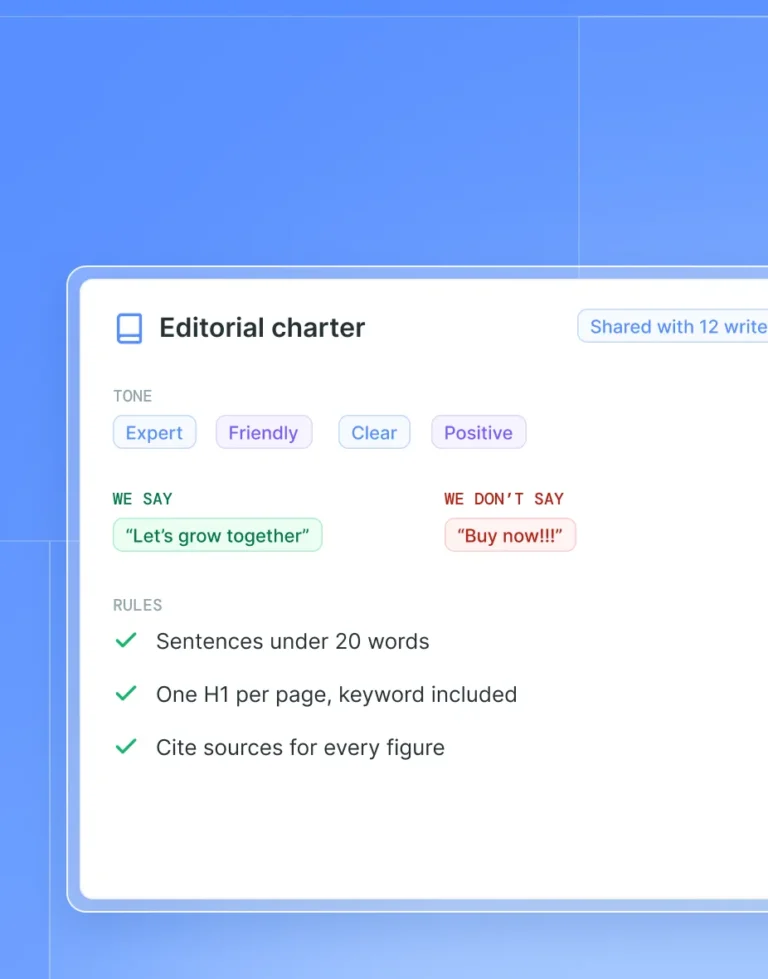
What is an editorial charter for a company?
The editorial charter, an essential reference document.
An editorial charter serves as both a practical tool and a reference document for companies involved in web content production. This document ensures consistency in the content production process by ensuring that all stakeholders adhere to the same editorial guidelines, graphic design principles, thematic coherence, and more. In essence, an editorial charter is a crucial element of any content marketing strategy, whether in web or print format, for both internal (company journal, corporate magazine, etc.) and external communication (blog articles, white papers, infographics, social media posts, email campaigns, etc.).

The usefulness of an editorial charter
Primarily used in inbound marketing, an editorial charter is a reference document that addresses all individuals involved, directly or indirectly, in content production on behalf of the company.
By establishing writing rules, graphic design guidelines, and communication objectives, an editorial charter provides precise instructions for web copywriters and graphic designers. Its purpose is to ensure the consistent creation of content that reflects the company’s identity, values, and meets its needs.
« The consistency of a brand is the key to building trust with consumers. »
A charter provides a clear direction for the editorial style across all content types, while capturing the unique aspects of the brand identity, including brand personality, writing tone, production environment, and more.
Good to know
It’s important to distinguish between an “editorial charter” and an “editorial line.” The editorial line refers to the thematic “common thread” that should characterise content production and bring coherence to the brand’s editorial strategy. It guides the selection of topics to address and also influences the writing approach – including the angle, tone, vocabulary, and style. The editorial line should therefore be integrated into your web editorial charter.
What does an editorial charter bring to your company?
Why create an editorial charter?
An editorial charter is not just another document destined to gather (digital) dust; it is an essential cog in the content production process and, more broadly, in the company’s communication. All types of content you publish, whether on your website or on third-party platforms that you don’t control (such as social media or partner sites), from simple blog articles to YouTube videos, serve your brand identity and should convey a consistent image. This is particularly true on the Internet, given the diversity of platforms and channels used by internet users. Without a web editorial charter, you run the risk of diluting your message and spreading an inconsistent image that could undermine your objectives.
What are the benefits of an editorial charter?
Achieving communication objectives
An editorial charter helps you achieve your communication objectives in terms of content quality, targeting prospects and customers, or internal communication.
Enhancing brand awareness
To gain recognition, a brand must be consistent, maintaining the same identity across all content and platforms. An editorial charter forms the foundation upon which your brand’s reputation is built.
Reinforcing SEO strategy
A content marketing strategy also serves SEO objectives. Therefore, a web editorial charter should encompass all aspects of your company’s SEO strategy.
Ensuring content quality
A consistent brand image promotes customer loyalty and engagement. If customers can identify with the brand, they are more likely to become brand advocates.
Converting leads into customers
Brand awareness helps acquire leads. However, it is the strength of the brand identity that builds trust and turns leads into loyal customers.
Retaining and engaging customers
Consistency in brand image promotes customer loyalty and engagement. When customers identify with the brand, they are likely to become brand ambassadors.
Establishing your brand as an expert
A consistent brand identity also demonstrates the company’s expertise in its field, particularly when conveyed through various types of content.
Maintaining control of your digital reputation
A strong brand is better equipped to maintain control of its online reputation by consistently producing content that serves its interests and addresses any negative feedback.
Building a brand community
A consistent brand forms the foundation of a digital community, where the brand’s values align with the expectations of internet users. The coherence provided by an editorial charter is therefore crucial.

Good to know
The graphic design style guide is distinct from the editorial charter, although it remains an essential component. This guide establishes the rules for using the brand’s visual identity in all aspects (logo, colours, typography, etc.) and formatting different types of content. It is primarily intended for graphic designers.
« To be faithful to a brand, consumers need to share its values. »
How to establish an editorial charter
The importance of creating your own editorial charter
There isn’t just one “editorial charter,” but rather multiple charters, each tailored to the specific needs of the company that creates it. Therefore, there are no hard and fast rules: this reference document can be as concise as a single page or as comprehensive as several centimetres thick. The key point when creating your web editorial charter is to ensure it encompasses all the essential elements for producing coherent content that aligns with your brand identity, including writing guidelines, graphic design principles, and editorial guidelines. The next step is to explore how to effectively implement it.
Steps of a brand content strategy
What should be included in your web editorial charter? Take a look at the following steps to create one.
Briefly introduce your brand
An editorial charter is both an internal document and an external communication tool. It presents your brand, its history and values, and the editorial team: project managers, graphic designers, web writers and content managers.
Result: everyone who creates content shares the same understanding of your brand.
Outline your editorial strategy
Define the purpose of your content marketing strategy, your communication objectives and the framework of your content production. Include business goals, target audience, platforms, traffic sources, positioning and editorial calendar.
Result: a clear framework that gives every piece of content a purpose.
Define your editorial guidelines
Set the themes, the tone to use with your audience and the writing rules on structure, format, typography, links, vocabulary and style. Add your SEO strategy by listing the keywords to include.
Result: consistent, on-brand content, whoever writes it.
Create your visual identity
Your graphic design principles define your logo, colours and typography, as well as images, illustrations, formats, dimensions and file sizes. These elements must reflect your brand values.
Result: content that is instantly recognisable as yours.
List your editorial formats
List the formats your teams will create, for internal communication (annual reports, internal mailings, podcasts) and external communication (blog articles, case studies, videos, social posts, landing pages). Set writing and design guidelines for each.
Result: clear rules for every format, so quality stays consistent.
Specify your SEO strategy
Define the keywords to include after a semantic audit and adapt the writing guidelines to search engine ranking criteria. Set an internal linking strategy from the start.
Result: an SEO-friendly web editorial charter that helps every piece of content rank.
Our Commitment
Expertise
Since 2010, we have worked with over 2000 clients across 90 countries.
Passion
We are a team of passionate, industry-focused individuals who are committed to your success.
Performance
We’re committed to implementing a data-driven strategy, making a real impact on your bottom line by providing avenues for growth.
Any questions?

Let’s talk