Social Media Video: The Complete Guide
Social media videos have become essential for increasing visibility and driving engagement. Discover how to create captivating videos specifically designed for social media platforms.
What is a social media video?
Why choose the video format for social media communication?
A social media video refers to video content created specifically for platforms like Facebook, Instagram, and YouTube. These videos are typically short in duration and crafted to grab and hold the attention of viewers as they scroll through their social feeds. The goal is to inspire actions such as likes, comments, shares, conversions, and even purchases. By briefly interrupting users’ browsing experiences for a few seconds or minutes, social media videos serve as a major catalyst for engagement, and their impact can be easily measured. This makes them an incredibly valuable marketing tool for businesses and brands.
Out of all the content types on social media – text messages, images, emojis, GIFs – videos reign supreme. According to Wyzowl, weekly online video viewing has nearly doubled between 2018 and 2022, going from 10.5 hours to 19 hours. On YouTube alone, more than 1 billion hours of video content are consumed daily. This increasing interest can be attributed to several factors: videos are easy to consume (short duration, ability to pause), require less concentrated attention than text, and offer more information than a simple image or GIF. Moreover, the wide variety of video formats caters to diverse preferences. Consequently, social media videos have played a significant role in shaping the digital landscape in recent years, with certain platforms relying exclusively on this format (such as YouTube or TikTok).
Why create videos for social media?
Making social media videos: why do it?
How do businesses benefit from creating videos on social media? What advantages can be expected from a video-based marketing strategy?
Capturing audience attention
Social media videos are an excellent way to grab your audience’s attention. In an age of information overload, where internet users are bombarded with vast amounts of content, video has the advantage of catching the eye and capturing attention. This is especially true as social media algorithms tend to favour video formats, as they increase the duration of interaction.
Driving user engagement
Videos have the power to convey a lot of information in a short amount of time, attract and maintain attention, as well as generate positive emotions and create stronger connections. Therefore, they are a powerful driver of engagement. In fact, a video post on certain platforms can generate engagement levels ten times higher than a post without video (such as on Twitter).
Attracting new audiences
A social media video also has the ability to attract the attention of audiences beyond your existing community. For example, on Instagram, stories can be made public, making them visible to any user. Additionally, videos have a relatively long lifespan (up to several months on TikTok), which increases their potential visibility.
Standing out from competitors
A vast amount of content is created on the web every day. However, through the use of video format, businesses can more easily differentiate themselves and stand out from their competitors to attract public attention and drive conversions. This is particularly true among younger generations: according to HubSpot (based on a survey about YouTube), 50% of those under 34 say they ‘couldn’t live without’ videos.
Generating more conversions
Like any web content, a social media video should be part of a marketing strategy and aim for a specific goal: prompting the viewer to interact with the content, connect to a website, make a purchase of a product/service, and more. Furthermore, a video can also be a powerful sales tool, as many internet users express a higher likelihood of purchasing a product/service after watching a video on a social network.
What are the different types of social media video?
Social media videos: what are the options?
If you’re considering creating your first social media video, you’ll soon find yourself faced with a plethora of possibilities. The options vary across different platforms: on Instagram, you can post videos on the feed or in stories, create short videos (Reels) or longer ones (IGTV), and even go live. Facebook offers classic video posts alongside 360° videos, Live videos, stories, and slideshows. On Twitter, you can share simple videos or ones that include polls or compelling calls-to-action (CTAs). And let’s not forget about the video features integrated into ads! Whatever your choice may be, you’ll always need to ask yourself the same questions before creating a social media video: which screen format should you choose? What is the ideal length for this type of content? And, most importantly, what story do you want to tell?
Screen format
Choosing the right screen format (the height-to-width ratio) is crucial for effectively conveying your message through social media videos. Here are the most common formats to consider:
Square format
Ideal for beginners, the square format (1:1) offers excellent compatibility across various browsing devices such as computers, smartphones, and tablets. You can’t go wrong with this format.
Vertical format
The vertical format comes in a 4:5 ratio for feeds and a 9:16 ratio for Stories and Reels. It’s perfectly adapted to the shape of smartphone screens.
Horizontal format
The landscape format with a 16:9 ratio (commonly used on YouTube and Twitch) is well-suited for desktop screens. However, viewers may need to rotate their phones to watch videos in this format.

Ideal duration of a social media video
When it comes to social videos, brevity is seen as an advantage. Short formats, especially those under 15 seconds, tend to be the most successful. On average, a video tends to lose about a third of its viewers after 30 seconds, and 45% after one minute. Different social media platforms have their own rules regarding video duration: stories usually have a maximum length of 15 seconds, IGTV videos on Instagram or native videos on LinkedIn can be up to 10 minutes long, Twitter allows videos of up to 140 seconds, and TikTok videos can be up to 3 minutes. However, it’s worth noting that longer videos can still be successful. On YouTube, longer formats are quite common and can attract millions of views.

What subjects should you focus on in your social media videos?
To determine the content of your videos, it’s important to understand what motivates internet users to watch them. Similar to past generations who tuned into TV or radio to unwind, today’s internet users primarily seek relaxation, as revealed by a survey conducted by HubSpot. However, relaxation is not the sole reason. Users also click the “play” button to learn something new, explore their interests, have fun, find inspiration, escape from the world around them, stay informed, and more. In essence, users want to be entertained while also being informed about topics that align with their interests.
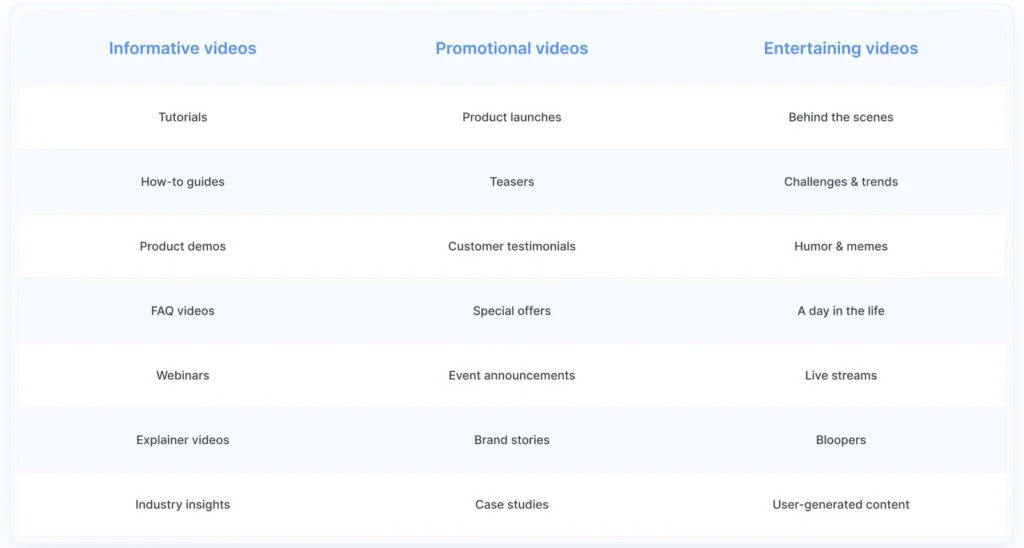
The different types of videos you can create
Dealing with multiple publishing channels is not just a challenge; it is a major aspect of any social media marketing strategy. Even if you already have a stock of videos, you may not be able to repurpose them for social networks. Each platform has its own cultural and technical constraints, influenced by both their specifications and the behaviour of their audiences. While the idea of creating different content for each social network may seem complex and frustrating—a live video for Facebook, a story for Instagram, a long video for YouTube—it is, nevertheless, the best strategy to adopt. If you don’t have the time or resources to focus on a multi-channel strategy, it’s best to concentrate your efforts on one or two platforms.
What type of video is best for each social network?
Every social network has its unique video landscape
Understanding the specifics of social networks to create engaging videos
YouTube
YouTube is well-suited for long and informative videos that address the questions viewers have. The preferred format is 16:9 (1920 x 1080 pixels), but the screen size supports various ratios. Don't forget to optimise your content for search since YouTube functions as a large-scale search engine (and is directly linked to Google).
On Facebook, users primarily seek entertainment and discover new things, such as news, products, services, and advice. The options are diverse. Videos are shared among friends and their communities. While the recommended format is vertical with a resolution of 1280 x 720 pixels, each format has its own specific parameters, such as 4096 x 2048 pixels for 360° videos.
Videos hold a special place on Instagram, and user expectations are higher than ever. Creativity and originality are key, as they have the potential to reach a vast audience—500 million people engage with Stories! It's also an ideal platform for promotional social media videos. The preferred resolution (1080 x 1080 pixels) varies depending on the type of video.
The haven for short videos, Twitter is a platform that is more focused on B2B and information sharing. What matters here is the authenticity and quality of the message being conveyed, so there's no need to spend too much time perfecting the quality. The ideal resolution is 1920 x 1200 pixels in landscape mode and 1200 x 1920 pixels in portrait mode.
TikTok
The youngest of social media platforms has built its success on the brevity of content. While the maximum duration was once limited to 60 seconds, it's now been extended to 3 minutes, though the average length of videos ranges between 9 and 15 seconds. Among other peculiarities, TikTok videos heavily rely on sound and prioritise entertainment, including songs, dances, sketches, games, contests, and more. The format is exclusively vertical with a resolution of 1080 x 1920 pixels.
LinkedIn's professional aspect is reflected in the videos published on the platform, which are primarily corporate-focused, product/service-oriented, or dedicated to personal branding. Your audiences expect to find information, updates, interviews, conferences, and more related to your company. Another specificity is that videos have a relatively short lifespan as they quickly disappear from the news feed. The default resolution is 1920 x 1080 pixels.
Similar to YouTube, the Pinterest network is primarily dedicated to discovery. Users come here to find information, ideas, inspiration, advice, and things to buy. An effective social media video on Pinterest will take the form of a guide or tutorial or offer a product/service that aligns with the subscribers' interests. Here, most ratios are accepted, both in vertical and horizontal formats.

Good to know
Among the top 10 most downloaded mobile apps, social networks dominate: TikTok, Facebook, and Instagram are in the top five (source). It’s estimated that over 85% of social media traffic comes from mobile devices. As a result, it is important to create a mobile-optimised social media video, ideally designed in a vertical orientation to save users from having to rotate their devices, and with subtitles to overcome sound-related issues.
How to produce engaging social media videos
Best practices for creating your social media video. Irrespective of the type of video, format, duration, and other factors to consider, the key to creating a compelling social media video is to dive right in! Discover the following best practices for producing your initial content.
Define your target audience
Before creating a social media video or a social media marketing strategy, define your target audience using your marketing personas. You will better understand their needs and expectations.
Result: videos designed for your typical customers, published on the networks they use most.
Adapt to the social network
Each social platform has its own conventions, features and users: you do not post the same thing on Instagram, YouTube and Facebook. Your social media video must fit the targeted network.
Result: the right video type, format, resolution and tone for each social network.
Find relevant topics
A business social media video addresses a topic, conveys a message or tells a story. Find ideas in your popular blog articles, your most shared content and what competitors do.
Result: topics already proven with your audience, which maximise engagement.
Create value
Every social media video should bring value to your audience, whether they want entertainment, information or discovery, while serving your marketing strategy. Include visual elements that make your brand instantly recognisable.
Result: videos that are useful for your audience and profitable for your business.
Always get straight to the point
Except on platforms like YouTube, social media videos should be short, as you lose much of your audience after a few minutes. Think “snack content”: brief and valuable, in both message and presentation.
Result: easy-to-watch videos that viewers watch to the end.
Quickly capture attention
You have only a few seconds to grab your audience’s attention and convince them to keep watching. Spark curiosity from the start with a question, a promise, an inspiring quote or striking visuals.
Result: a higher watch rate and social media videos that hold viewers.
Don't forget to add subtitles
Most users watch social media videos without sound, in public or because sound is off by default. Add subtitles and overlay text to highlight key points.
Result: content everyone can follow, even on mute, with key messages better remembered.
Include a relevant call-to-action
At the end of your social media video, guide viewers with a call-to-action matching the action you want. Unless the video is about a product, avoid overly promotional CTAs and prefer a link to another video or an invitation to interact.
Result: viewers who continue their journey with your brand instead of leaving.
Actively promote your video
Once published, your social media video appears in feeds or a dedicated section, for subscribers or all users depending on settings. Promote it actively with links in various places and invitations to watch.
Result: wider reach beyond your community and more views for each video.
Measure your marketing ROI
Track each social media video closely: views, total watch time and interactions. These metrics measure the reach of your posts throughout your social media marketing campaign.
Result: a clear view of what works with your audience and a video strategy adjusted for better marketing ROI.
Good to know
The engagement rate generated by a social media video can vary greatly depending on the day and time of its publication. What is the “right” time to post a video? Each platform is different: on Facebook, it’s better to publish from Tuesday to Friday, preferably in the afternoon. On Instagram, it’s Tuesday and Friday, etc. Do your research before posting!
Any questions?

Let’s talk